
Lead magnets are one of the most misunderstood tools in the online coaching business.
Everyone says, “Give value. Offer a freebie. Build your list.”
Most advice sounds simple enough, but it’s also incomplete.
None of that is wrong; Lead magnets are free things, make it easy to create, super easy to say yes, but only sticking to this advice is also where most lead magnets stop working. And you know lead magnets are the foundations of a scalable coaching business, and yet we go wrong here.
While many lead magnets are created to collect email addresses, the ones that actually convert are designed to do something else entirely; they prepare people to take the next step. They are designed to build relationships.
A well-crafted lead magnet doesn’t just bring people in; it gives them a first experience of your transformation.
It’s not another checklist or PDF lost in someone’s downloads folder. It’s a bridge that connects curiosity to commitment.
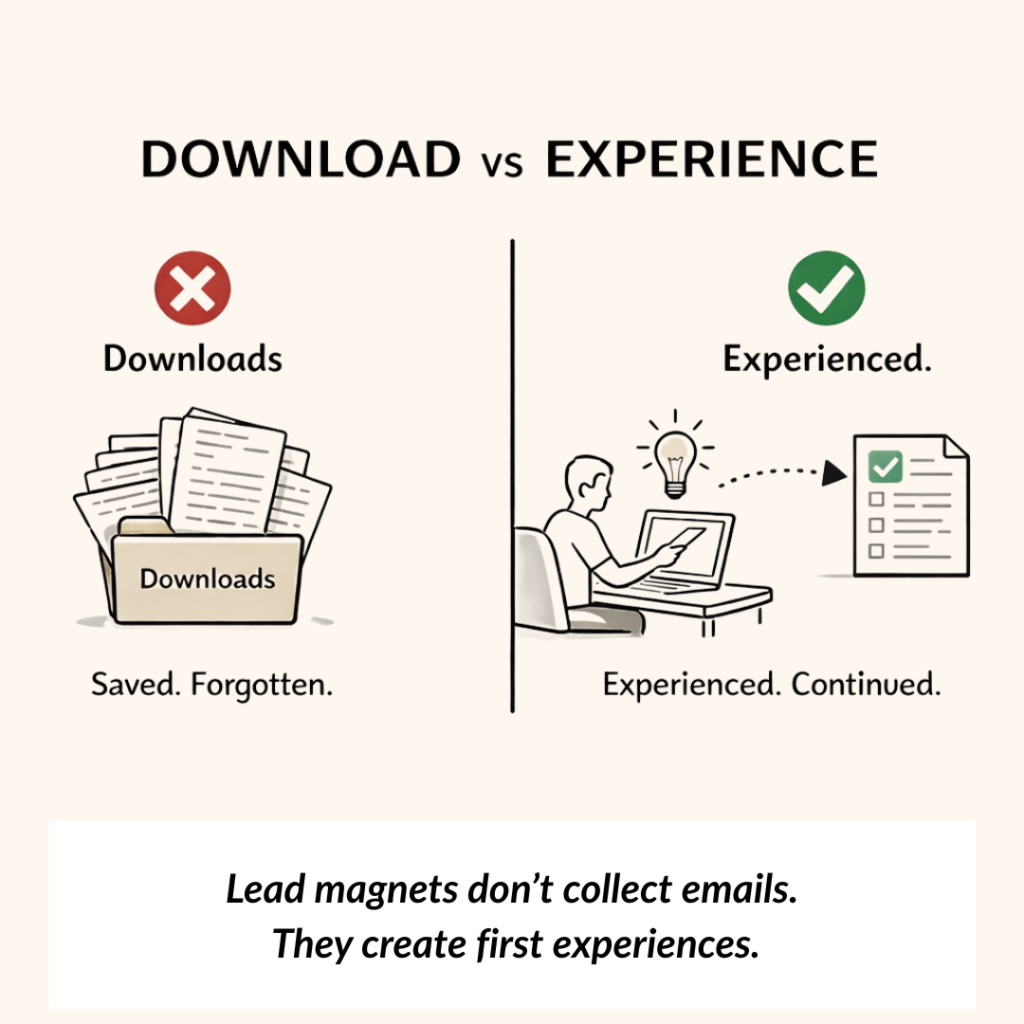
If your freebies get attention but don’t lead to action, it’s rarely a traffic problem. More often, it’s a design problem. Specifically, a decision-design problem.
This post breaks down how high-converting lead magnets are actually created from a decision-making lens, so they attract buyers and not just end up adding cold subscribers to your list.
Why Most Lead Magnets Don’t Convert
Most lead magnets fail because they’re created in isolation. ( I have a detailed blog on this – 6 Lead magnet mistakes)
They’re treated as “something free” rather than as an intentional entry point into a larger journey. When that happens, people opt in, consume the content, and move on because nothing guided them forward. They have no idea what you sell or how you could support them. There is no ecosystem behind the lead magnets.
In many businesses, the lead magnet exists as a standalone asset. It isn’t connected to messaging, offers, or long-term positioning. It’s created because “you’re supposed to have one,” and not because it plays a defined role.
Your business does need these types of lead magnets, but they shouldn’t be the only ones you rely on.
When lead magnets underperform, it’s usually because one or more of these issues are present:
- They’re too broad or generic
- They attract curiosity rather than readiness
- They aren’t connected to a paid offer
- They’re designed to maximise opt-ins instead of decisions
Each of these points sounds small on its own. Together, they explain why so many businesses grow lists that don’t convert.
The lead magnet technically does its job; it attracts people. But it doesn’t do the more important job of preparing them. It doesn’t shift how they see their problem, their options, or themselves.
That gap is where conversion usually breaks down, and we need to cater to those gaps to make sure you are driving aligned leads in your online coaching business.
What “High-Converting” Actually Means in regard to Lead Magnets?
I know the word high converting sounds like a typical bro style guru word. Don’t get me wrong, in any case, you need your lead magnets to bring in buyers. And to bring in buyers, your lead magnet needs to convert people. So that’s what we call high converting.
Don’t go with the literal definition of high converting means getting maximum downloads. Yes, this is correct if you only look at the lead magnet from the opt-in point of view. But we are looking for a total funnel viewpoint, and that’s where we go deep beyond this layer.
Most of us stick to this so hard that we end up with a lot of poor design decisions.
The Conversion in this context means sales and also the movement. It could also be sales conversations. Is your lead magnet really starting a sales conversation?
A lead magnet converts when it helps someone move from one mental state to another. Specifically, when it helps someone move from:
- Passive Interest to Active Consideration
- Confusion to Clarity
- Awareness to Readiness
This kind of movement requires better framing and positioning. It also needs you to have 2-3 lead magnets to play different roles in your business
High-converting lead magnets don’t try to educate fully.
They don’t attempt to solve the entire problem. Instead, they orient the reader. They help them see what actually matters, where they might be stuck, and why their current approach may not be working. They actually activate people so they are ready to take action. (I have a post on what makes a lead magnet attract buyers if you wanna dive deep)
A lead magnet that educates fully leaves people overwhelmed and stuck without taking action.
This is why list building works best when it’s treated as part of a system rather than a growth tactic. When the goal is only growth, lead magnets stay shallow. When the goal is progression, they become powerful.
Designing Lead Magnets by Their Role and Not Just the Format
One of the most effective shifts you can make is to stop thinking in formats and start thinking in roles.
Formats are containers. Roles are intentions.
When you design by format, you ask questions like:
Should this be a checklist?
Should this be a PDF?
Should this be a free training?
When you design by role, you ask something far more useful: What decision is this meant to support?
Every effective lead magnet plays a specific role in the buyer journey. Broadly speaking, most lead magnets fall into one of three categories:
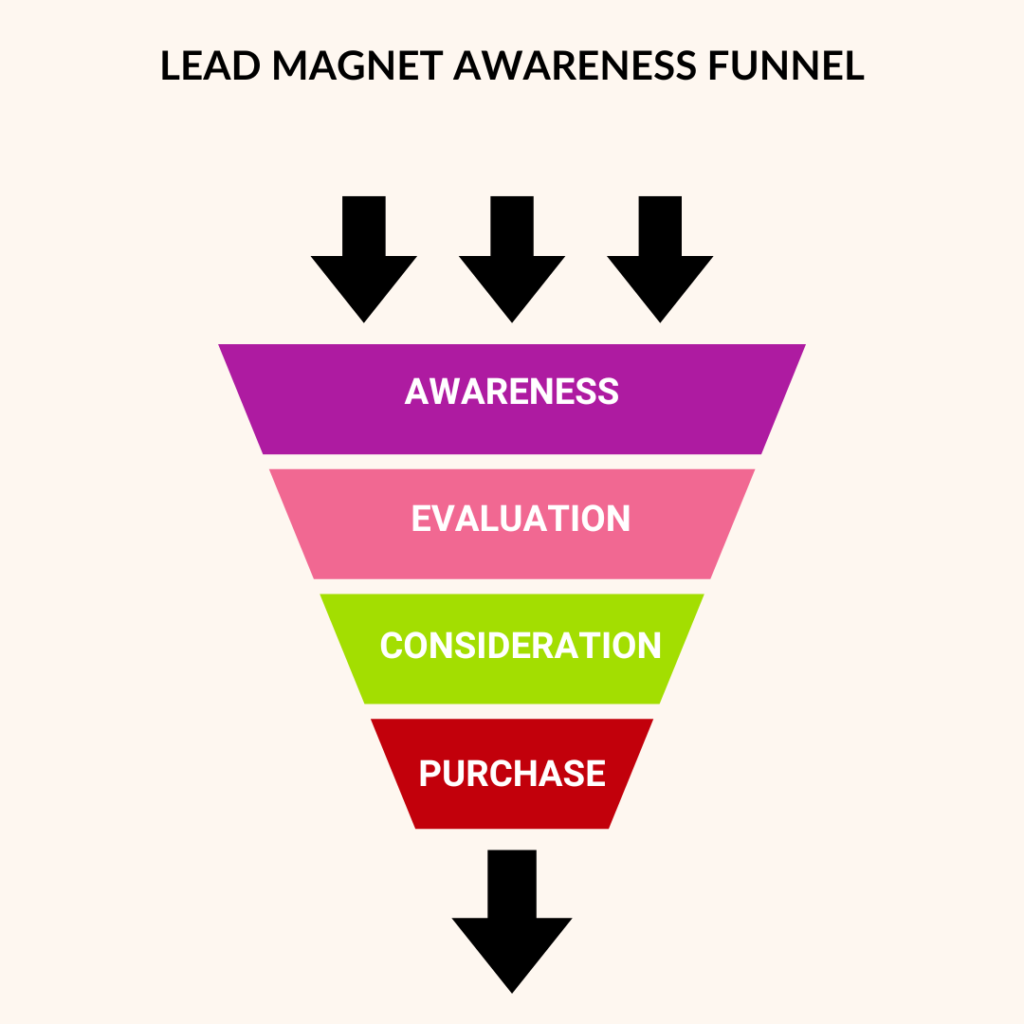
Awareness
These speak to people who are just recognising a problem. Their role is not to convince, but to introduce language, context, or a new way of seeing what’s happening. They help someone say, “That’s exactly what I’m dealing with.”
Evaluation & Consideration
These help people evaluate options, approaches, or beliefs. They often challenge assumptions, compare paths, or explain why certain strategies work better than others. Trust deepens here.
Purchase
These speak to people who already understand their problem and are close to acting. Their job is to remove hesitation and clarify why your approach is the right next step.
Many lead magnets fail because they’re misassigned. They stay stuck in awareness even when the business actually needs decision-ready leads. And most businesses only have awareness-level lead magnets and nothing down in the funnel.
The Buyer-Ready Lead Magnet Thinking
When lead magnets are designed with buyer intent in mind, they stop functioning like generic freebies and start functioning like decision tools.
This is the thinking behind buyer-ready lead magnets.
Instead of asking, “What will attract the most people?” the question becomes, “Who is already close to deciding, and what do they need to move forward?”
Buyer-ready lead magnets typically:
- Speak to people who already know their problem
- Address the real belief or hesitation stopping action
- Naturally position the paid offer as the next step
These lead magnets almost always attract fewer opt-ins; their role is to filter people and take them further down the funnel.
Fewer opt-ins don’t mean lower performance. It usually means higher alignment. The people who do opt in are clearer, warmer, and far more likely to convert because the lead magnet wasn’t designed to appeal broadly. It was designed to resonate deeply.
This is where many businesses hesitate and where a lot of growth potential is lost. The fear of “fewer leads” often prevents people from creating the lead magnets that would actually generate revenue.
What Actually Makes Buyers Take the Next Step
When you look past format, high-converting lead magnets tend to share a few consistent characteristics. They are:
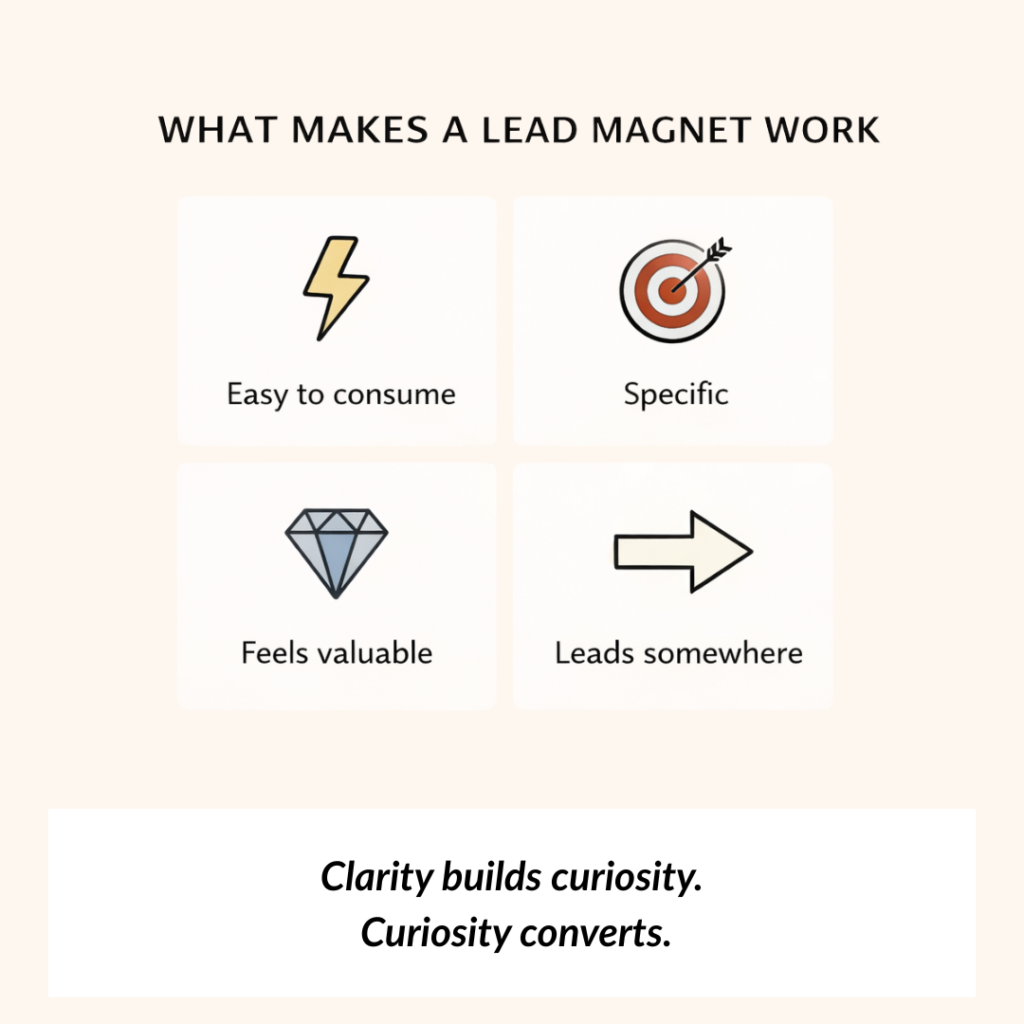
Specific: One problem, one insight, one result. Simplicity converts.
They focus on one clear problem and one meaningful outcome. Not five problems. Not an overview. One shift that matters.
Valuable: It feels valuable. Your audience should think, “If this is free, imagine her paid work.”
The free resource makes sense as a precursor to what you sell. It feels like the first chapter, not a separate book.
Belief-shifting, not information-heavy: It’s easy to consume. No 40-page eBooks. People love quick, focused wins.
They change how someone sees their situation instead of overwhelming them with tactics or tools.
Clear in continuation: It leads somewhere. The next step should be obvious, whether that’s a tripwire, a webinar, or a deeper offer.
The next step feels obvious. There’s no confusion about what to do after consuming the lead magnet.
This is why giving more information rarely increases conversions. Information feels useful, but clarity creates movement.
Common Design Mistakes That Quietly Kill Conversion
Even strong ideas struggle to convert when certain design mistakes creep in.
The most common ones I see are:
- Choosing the format before the idea
- Trying to solve everything in one free resource
- Having no clear next step after the opt-in
- Designing for opt-ins instead of alignment
These mistakes usually don’t happen intentionally. They happen when people rush creation or design from comparison instead of clarity.
The result is often a lead magnet that looks good, reads well, and still doesn’t convert, a pattern I explore further when breaking down common lead magnet mistakes that stop conversions.
Choosing the Right Lead Magnet Idea (Without Guessing)
For most people, the hardest part of creating a high-converting lead magnet isn’t execution.
It’s choosing the right idea.
Not every good idea makes a good lead magnet. Some ideas are better suited for blogs, some belong in emails, and some work best as paid material. And some ideas only work as lead magnets when they’re positioned correctly.
This is where intentional idea selection matters.
If you want structured inspiration without falling into comparison or random creation, this is exactly why I created 50 Lead Magnet Ideas That Convert, a curated set of ideas designed to help you think in terms of alignment, buyer readiness, and role before execution.
The right idea, placed correctly, can support your business for years. The wrong idea, no matter how well designed, will always struggle.
The Hidden Power of a Lead Magnet that Builds Authority
Your lead magnet isn’t just about getting subscribers; it’s about shaping perception.
When someone signs up to receive something from you, they’ve already made a small but powerful decision: They’ve said, “I trust you enough to let you guide me.”
That’s where real authority begins. The right lead magnet positions you as the go-to expert long before a purchase happens. It’s how people start to associate your name with the solution they’re searching for.
Even if they don’t buy right away, that trust compounds over time.
And the moment they’re ready, they’ll think of you first, because you were the one who gave them clarity when others gave them noise.
The Freebie Trap: Why Some Lead Magnets Attract the Wrong Audience
If your inbox is full of praise like “This was amazing!” but your Stripe account is quiet, you’re not alone.
That’s the “Freebie Trap”, when your free content educates people so much that they don’t feel the need to invest further.
This happens when lead magnets give too much without guiding people toward the next step. The goal isn’t to impress/overdeliver to your audience. It’s to empower them to take action.
So next time you create a freebie, ask yourself: “Am I giving clarity, or am I giving everything?”
Giving everything keeps people inspired but inactive. Giving clarity helps them decide to invest. I have struggled for a long time in the freebie trap.
When I created my very first lead magnet, it took me six months to release it.
I kept tweaking, designing, and waiting for it to be perfect, and in those six months, I collected zero leads.
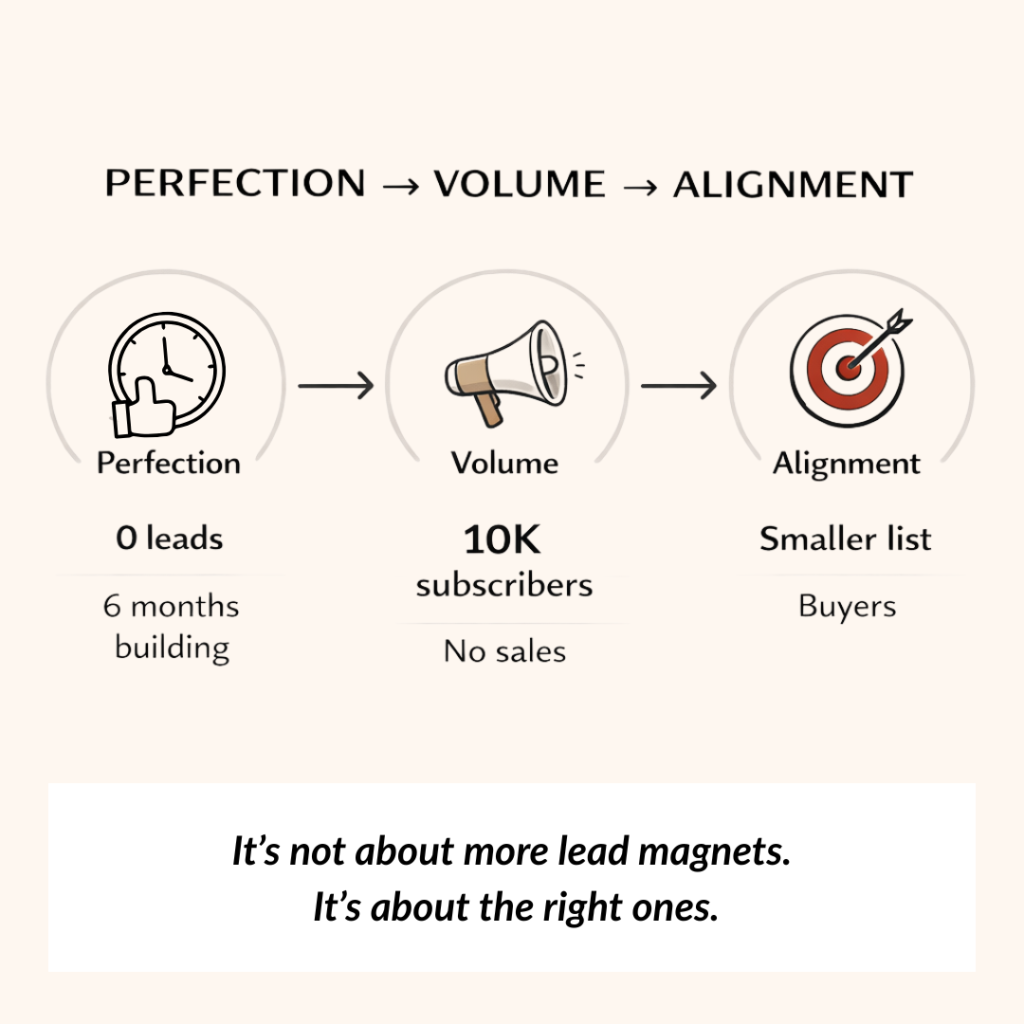
That experience taught me that done is better than perfect. So I swung to the other extreme, and I started creating one lead magnet after another. Checklists, cheat sheets, templates… everything that seemed to be working for others.
In total, I created more than fifty different lead magnets, and my list grew fast, reaching 10,000 subscribers.
It looked like success. But behind the scenes, I was still broke.
The truth was, my lead magnets had nothing to do with my actual business.
They brought people in, but not the right ones. I had built a big list with no connection to my offers.
That’s when it clicked for me: it’s not about more lead magnets, it’s about the right ones.
I deleted most of my freebies, kept only a few that truly aligned with my business, and rebuilt my list intentionally.
It was a full-circle moment: I realised lead magnets aren’t about getting names on a list, they’re about bringing the right people into your world with something they’d pay for.
When you connect your lead magnet to your paid work, and it’s designed with alignment and intention, the same “freebie” that others fear will become your most profitable growth tool.
That’s why even today, my email list is my biggest revenue driver.
Final Thoughts: Design for Decisions and Not Just Downloads
High-converting lead magnets aren’t built by giving more.
They’re built by giving direction.
Your lead magnet will stop attracting passive subscribers and start attracting people who are prepared to move forward if your lead magnet knows its role, reflects your paid work, and speaks to the right stage of buyers
And when that happens, list building stops feeling random. It starts feeling intentional.
If you want help turning this thinking into a lead magnet that actually converts, that’s exactly what I walk through inside the Buyer Ready Lead Magnet Formula.
Because in the end, your lead magnet isn’t there to grow your list. It’s there to grow your business.
Enjoyed reading this blog? Let me know by connecting with me on Instagram-@asmitajason or writing to me at hello@asmitajason.com.
Don’t forget to check all the amazing free resources I have for you on my freebie page; looking to work with me on a deeper level? Check out my everything page.